
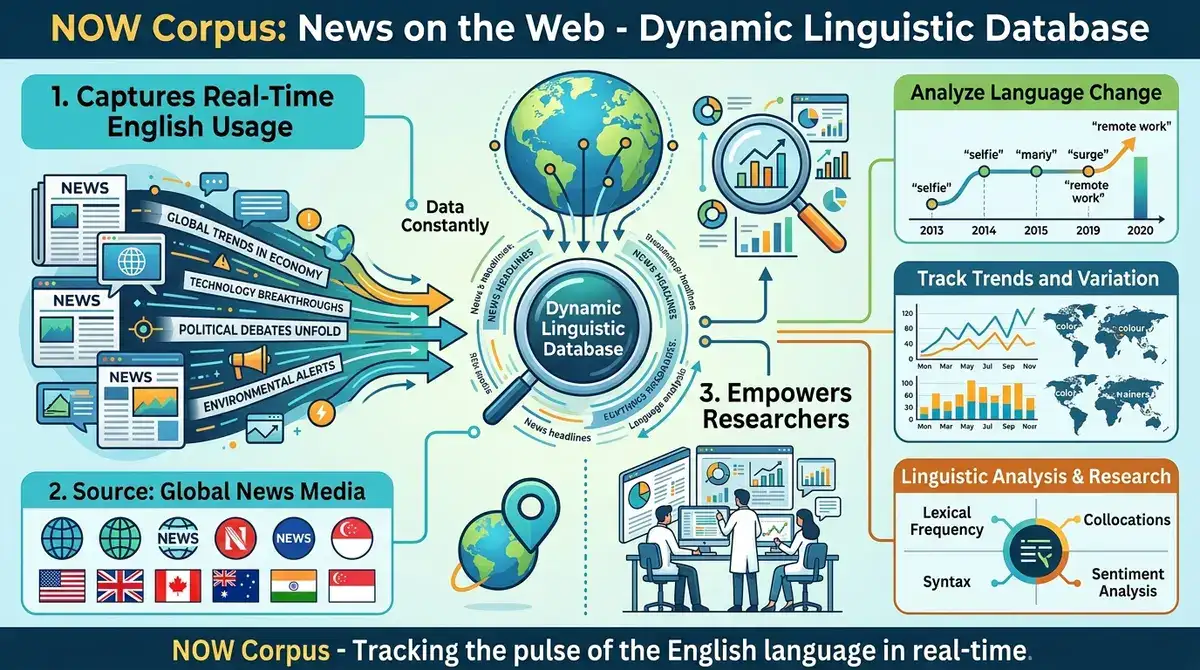
The NOW Corpus (News on the Web) is a large-scale, continuously updated linguistic database that collects and organizes English language data from online news sources around the world. It is designed to capture how modern English is actually used in real-life communication, particularly in journalistic writing.
Unlike traditional corpora that are built from a fixed set of texts collected within a specific time period, NOW Corpus operates as a monitor corpus, meaning it is constantly expanding. New data is added regularly, allowing the system to reflect ongoing changes in language use over time.
This dynamic structure makes NOW Corpus especially important for studying contemporary English in context, rather than historical or static forms of the language. Researchers, educators, and linguists use it to observe how vocabulary, grammar, and expression evolve as global events influence public discourse.
At a fundamental level, NOW Corpus serves three main purposes:
- It provides access to real-world English usage drawn from large-scale news media
- It allows observation of language change as it happens over time
- It connects linguistic patterns with real-world events and topics
Because of these characteristics, NOW Corpus is not just a collection of texts, but a continuously growing representation of how English functions in the modern world.
What Makes NOW Corpus Different from Other Corpora
The NOW Corpus is different from many traditional linguistic corpora because it is designed as a living, continuously updated system rather than a fixed dataset. Most english corpora are built from a selected collection of texts that represent a specific time period, meaning they remain static after publication. In contrast, NOW Corpus is constantly expanding with new material, making it far more dynamic and reflective of current language use.
One of the most important distinctions of NOW Corpus is its real-time monitoring capability. As new articles are published in online news media, they are continuously added to the corpus. This allows users to observe how English evolves almost in parallel with real-world events. Instead of analyzing language from the past, researchers can study language as it is actively being used today.
Another key difference lies in its focus on contemporary news discourse. While other corpora may include literature, spoken transcripts, or historical documents, NOW Corpus is centered on journalistic English from global online news sources. This provides a consistent and structured form of language that is still highly responsive to current events and global trends.
Because of this design, NOW Corpus is particularly useful for identifying:
- Rapid changes in vocabulary usage
- Emerging expressions tied to current events
- Shifts in meaning influenced by media coverage
In essence, NOW Corpus is not just a repository of language data, but a system built to track how English changes in real time, making it fundamentally different from static linguistic databases.
The Structure and Design of NOW Corpus
The NOW Corpus is built with a structured design that allows it to function as a large-scale, continuously expanding linguistic database. Its architecture is based on three core principles: systematic data collection, time-based organization, and scalable expansion. This structure is what enables it to capture real-world English usage in a consistent and analyzable form.
At a general level, the corpus is not simply a collection of texts. Instead, it is an organized system where each piece of data is categorized, time-stamped, and indexed for linguistic analysis. This makes it possible for users to search, filter, and compare language usage across different time periods and regions.
Data Sources and News Coverage
The data in NOW Corpus comes primarily from online news media sources across multiple English-speaking regions. These include newspapers, digital news platforms, and other journalistic publications that produce content in English.
The selection of news-based sources is intentional. News writing provides a relatively standardized form of language that is widely produced and consistently structured, making it suitable for large-scale linguistic comparison. At the same time, because news is closely tied to real-world events, it also reflects current social, political, and cultural developments.
The inclusion of multiple regions ensures that the corpus captures global variations in English usage, not just a single national variety.
Continuous Updates and Real-Time Expansion
One of the defining characteristics of NOW Corpus is its continuous growth. Unlike static corpora, which are fixed once compiled, NOW Corpus is updated regularly with new articles from ongoing news production.
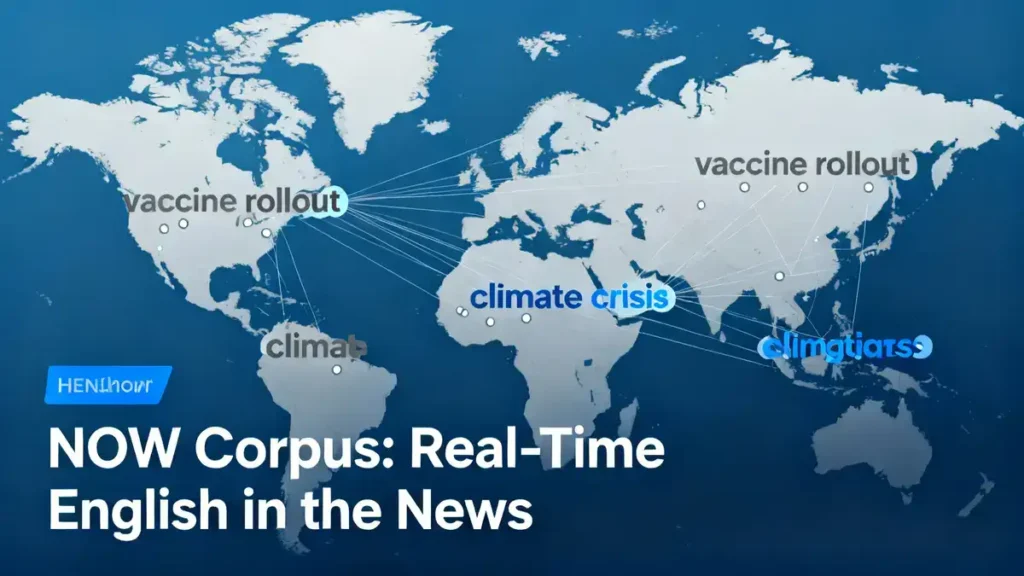
This continuous expansion allows the corpus to remain current and relevant. It also enables researchers to observe how language changes in near real time, especially in response to major global events such as political developments, technological innovations, or international crises.
Because of this structure, NOW Corpus is never “complete” in the traditional sense. It is always evolving alongside the language it documents.
Time-Based Organization of Data
Time is a central organizing principle in NOW Corpus. Every entry in the database is associated with a specific date, allowing users to track language usage across different time periods.
This time-based structure makes it possible to:
- Compare language use across years, months, or even days
- Identify trends in word frequency over time
- Analyze how specific events influence language patterns
By organizing data chronologically, NOW Corpus allows language to be studied not as a static system, but as a dynamic process that evolves continuously.
Real Example of Using NOW Corpus in Practice
To understand how NOW Corpus works in real usage, consider a simple query such as:
“climate change”
When this query is run in the corpus, the system returns multiple examples of how the term appears across different news articles and time periods.
What makes this powerful is not just the presence of the word, but the variation in context:
- In earlier years, the term may appear in discussions about environmental science
- In later years, it becomes more frequent in political and economic reporting
- During major climate events, usage spikes significantly in global media coverage
This demonstrates how NOW Corpus does not only show definition-based usage, but also contextual evolution of meaning over time.
How NOW Corpus Works in Linguistic Research
In linguistic research, the NOW Corpus is used as a tool for analyzing how English is actually used in real-world contexts rather than how it is prescribed in grammar rules or dictionaries. It provides researchers with large-scale, authentic language data that reflects natural usage across time, regions, and topics.
Unlike small text samples or isolated examples, NOW Corpus allows for empirical analysis at scale. Researchers can observe patterns that emerge only when language is studied across millions of words, making it especially valuable for understanding contemporary English as a dynamic system.
The core strength of NOW Corpus in research lies in its ability to connect language patterns with real-world events. Because the data is continuously updated and time-stamped, it becomes possible to analyze how external factors influence language use almost immediately.
Frequency Analysis in Real Context
Frequency analysis in NOW Corpus is not limited to counting how often a word appears. Instead, it focuses on how frequently words occur within specific contexts over time.
Researchers can track whether certain terms increase or decrease in usage, and relate these changes to real-world developments. For example, shifts in frequency often reflect changes in public attention, media focus, or social discourse.
This allows linguists to move beyond static definitions and observe how meaning is shaped by actual usage patterns.
Tracking Language Change Over Time
One of the most important applications of NOW Corpus is the study of language change. Because the corpus is continuously updated and organized chronologically, it allows researchers to compare language use across different time periods.
This makes it possible to identify:
- when new expressions first appear
- how quickly they spread in media discourse
- how meanings shift or evolve over time
Language is treated here as a living system, constantly adapting to new contexts rather than remaining fixed.
Studying Global English Variations
NOW Corpus includes data from multiple English-speaking regions, which makes it valuable for studying variation in global English.
Researchers can compare how different regions use vocabulary, structure, and phrasing to describe similar events or topics. These variations reveal how English adapts to local contexts while still maintaining global intelligibility.
This comparative perspective is essential for understanding English as a global language rather than a single standardized form.
Advanced Query Structure and Corpus Mechanics
Beyond simple keyword searches, NOW Corpus supports more advanced linguistic exploration methods.
Researchers often use techniques such as:
- Phrase-based queries → to analyze fixed expressions
- Collocation analysis → to identify words that frequently appear together
- Frequency distribution tracking → to observe usage changes over time
- Context window analysis → to study surrounding words and meaning shifts
These methods allow researchers to move beyond surface-level observation and into structural analysis of language behavior.
Understanding Word Trends Through NOW Corpus
One of the most valuable aspects of the NOW Corpus is its ability to reveal how word usage changes over time. Because it continuously collects data from global news sources, it allows researchers to observe how certain terms rise, decline, or shift in meaning depending on real-world events and social attention.
Word trends in NOW Corpus are not abstract patterns. They are directly connected to how people and media respond to developments in politics, technology, culture, and global crises. This makes the corpus a powerful tool for understanding not just language structure, but also language in relation to society.
Emergence of New Words and Expressions
New words often enter the language through media exposure. In NOW Corpus, researchers can trace the first appearances of emerging expressions and observe how they spread across different publications over time.
These new terms often originate from:
- technological innovations
- social or cultural movements
- political events or public discourse
- global crises that require new vocabulary
By tracking their growth in frequency, NOW Corpus helps identify when a term moves from niche usage into mainstream language.
Impact of Global Events on Language Use
Global events have a direct and often immediate effect on language. When major events occur, such as pandemics, elections, or international conflicts, certain words and phrases rapidly increase in frequency within news reporting.
NOW Corpus makes it possible to visualize these shifts clearly. It shows how language adapts in response to collective focus, reflecting what societies are actively discussing at any given time.
This connection between events and language use is one of the reasons the corpus is considered a valuable resource for studying contemporary English in context.
Case Study – Evolution of the Word “AI”
The term “AI” (Artificial Intelligence) provides a clear example of how language evolves in NOW Corpus.
Early Usage Phase
Initially, “AI” appeared mostly in technical or scientific contexts, often in discussions about computing and research.
Expansion Phase
Over time, usage expanded into business and industry-related news, especially as machine learning technologies became more commercially relevant.
Modern Phase
In recent years, “AI” has become a mainstream term appearing in:
- public policy discussions
- education
- creative industries
- everyday media headlines
This shift shows how a technical term can gradually transform into a general public discourse term.
Applications of NOW Corpus
The NOW Corpus is not only a resource for linguistic theory, but also a practical tool used across multiple fields. Because it provides large-scale, real-time data on contemporary English usage, it has applications in education, research, media analysis, and computational systems.
Its value lies in its ability to connect language data with real-world usage, making it useful for both academic and applied purposes.
Academic Research and Linguistics
In academic contexts, NOW Corpus is widely used for studying language structure, usage patterns, and semantic change. Linguists rely on it to analyze how English evolves over time and how meaning shifts in response to social and cultural developments.
It is especially useful for research that requires large datasets, allowing scholars to move beyond small-scale examples and observe language at a macro level.
Language Learning and Education
For language learners, NOW Corpus provides exposure to authentic English as it is actually used in modern contexts. Instead of relying solely on textbook examples, learners can observe real sentences taken from current news media.
This helps learners:
- understand natural phrasing
- recognize modern vocabulary
- develop awareness of real-world usage patterns
As a result, it bridges the gap between academic English and practical communication.
Media and Journalism Analysis
Journalists and media analysts use NOW Corpus to study how language is used in news reporting across different regions and time periods.
It helps identify:
- shifts in framing and terminology
- differences in reporting styles
- changes in public discourse over time
This makes it a useful tool for understanding how language shapes and reflects media narratives.
Computational Linguistics and AI
In computational linguistics, NOW Corpus is used as a large-scale dataset for training and evaluating language models. Because it contains diverse and continuously updated text, it provides valuable input for systems that rely on natural language understanding.
It also helps improve models that need to adapt to evolving language patterns, especially in modern digital communication environments.
How to Access and Use NOW Corpus
The NOW Corpus is designed to be accessible through an online interface that allows users to search, filter, and analyze large amounts of linguistic data. While it is a powerful research tool, its usage does not require advanced technical skills to begin exploring basic language patterns.

At its core, the interface functions as a search system for real-world English usage, enabling users to retrieve examples of words, phrases, and patterns from millions of news articles. However, to use it effectively, it is important to understand how the system organizes and presents data.
Basic Interface Overview
The NOW Corpus interface is built around a search-driven system. Users can input words or phrases into a search field, and the system will return occurrences of those terms from its database of news texts.
The results are typically displayed with contextual examples, allowing users to see how a word is used within real sentences rather than in isolation.
This structure helps users move from abstract vocabulary knowledge to context-based understanding of language usage.
Searching and Querying Data
Searching in NOW Corpus goes beyond simple keyword lookup. Users can refine their queries to explore patterns such as:
- specific word combinations
- grammatical structures
- variations across time periods
This makes it possible to investigate not only whether a word appears, but also how it is used in different contexts and timeframes.
By adjusting search parameters, users can narrow or expand their results depending on their research or learning goals.
Interpreting Results Correctly
One of the most important skills in using NOW Corpus is interpreting the results accurately. Because the corpus contains raw language data from real sources, context is essential.
A single word can have multiple meanings depending on its usage. Therefore, users must pay attention to:
- surrounding sentence structure
- publication context
- time period of usage
Without proper interpretation, raw frequency or examples can lead to misleading conclusions. Understanding context is what transforms data into meaningful linguistic insight.
NOW Corpus Compared to COCA and BNC
To understand the position of NOW Corpus in linguistic research, it is useful to compare it with other major corpora:
- COCA (Corpus of Contemporary American English)
A balanced corpus containing spoken, fiction, academic, and news texts. It represents structured modern American English. - BNC (British National Corpus)
A static corpus representing British English from a fixed historical period. - NOW Corpus
A continuously updated corpus focused on global news media, reflecting real-time language change.
Key Difference:
NOW Corpus is the only one designed to capture language as it evolves in real time, making it uniquely suited for studying modern linguistic change.
Limitations of NOW Corpus
Although the NOW Corpus is a powerful tool for studying contemporary English, it is important to understand that it is not a complete representation of the entire English language. Like any linguistic database, it has structural and methodological limitations that affect how its data should be interpreted.
Recognizing these limitations is essential for ensuring that conclusions drawn from the corpus remain accurate and contextually grounded.
Dependence on News Sources
One of the primary limitations of the NOW Corpus is its reliance on news media as its main data source. While news articles provide structured and consistent language, they represent only one specific register of English.
As a result, the corpus reflects:
- formal written language
- journalistic style conventions
- editorial and institutional perspectives
It does not fully capture informal, conversational, or personal forms of English used in everyday communication.
Bias in Media Representation
Because the corpus is built from news publications, it is indirectly influenced by media selection and editorial decisions. Different news organizations may prioritize different topics, regions, or perspectives, which can affect how language appears in the dataset.
This means that certain topics or expressions may be overrepresented, while others may be underrepresented depending on media coverage trends at a given time.
Understanding this bias is important when interpreting frequency patterns or language shifts within the corpus.
Limitations for Spoken Language Study
Another key limitation is that the NOW Corpus is based entirely on written text. It does not include spoken conversations, informal dialogue, or real-time speech patterns.
As a result, it cannot fully represent:
- spoken grammar variations
- conversational expressions
- informal slang used in daily speech
This makes it less suitable for analyzing spoken English, even though it is highly effective for studying written contemporary language in news contexts.
Why NOW Corpus Matters in Modern English Studies
The NOW Corpus plays an important role in modern English studies because it provides a continuously updated view of how the language is actually used in real-world contexts. Unlike traditional linguistic resources that capture language at a fixed point in time, NOW Corpus reflects English as a dynamic and evolving system.
This makes it especially valuable for understanding contemporary language, where change happens quickly due to global communication, media influence, and technological development.
One of its key contributions is the ability to connect language analysis directly with current events. This allows researchers to see how social, political, and cultural developments influence vocabulary and expression in near real time.
In addition, NOW Corpus supports a more empirical approach to language study, where conclusions are based on large-scale data rather than intuition or limited examples. This strengthens the reliability of linguistic analysis in modern contexts.
Overall, NOW Corpus helps shift the study of English from a static model to a living model of language, where change, variation, and context are central to understanding meaning.
A Living Database of Contemporary English
The NOW Corpus represents more than a linguistic resource; it functions as a continuously evolving record of how English is used in the modern world. Its structure allows it to grow alongside global communication, capturing language as it responds to real events, social changes, and cultural developments.
Unlike static databases that preserve language from a fixed period, NOW Corpus reflects English as a living system. Every new update adds another layer of contemporary usage, making it possible to observe language not as something completed, but as something constantly in motion.
This dynamic nature is what gives NOW Corpus its long-term value. It does not simply document English; it tracks its evolution in real time. Researchers, educators, and learners can observe how words emerge, shift in meaning, or decline in usage as society changes.
In this sense, NOW Corpus serves as a bridge between language and reality. It connects linguistic patterns directly with the world that produces them, offering a continuously updated mirror of modern English usage.
Ultimately, it stands as a reminder that language is never static. It grows, adapts, and transforms—just like the world it describes.
Leave a Reply