

COCA (Corpus of Contemporary American English) is one of the most powerful resources available for understanding how English is actually used in real life, not just how it is taught in textbooks.
Many learners and writers rely heavily on grammar rules and dictionaries. While these tools are useful, they often fail to answer a more important question: does this sentence sound natural to a native speaker?
This is why even grammatically correct sentences can sometimes feel slightly off.
The problem isn’t always about correctness, but about usage. How words are naturally combined, how phrases are commonly expressed, and how meaning changes depending on context.
This is exactly where COCA becomes incredibly valuable.
By providing access to real examples of English from conversations, news, academic texts, and media, COCA allows you to move beyond theory and start understanding the language as it is actually used.
What is COCA (Corpus of Contemporary American English)?
COCA (Corpus of Contemporary American English) is a large and structured database of real English language usage, designed to show how words and phrases are actually used by native speakers in everyday contexts.
Unlike a traditional dictionary, which only provides definitions, COCA allows you to explore how words appear in real sentences across different types of content. This includes spoken conversations, news articles, academic papers, fiction, and media.
The database contains hundreds of millions of words collected from a wide range of sources, making it one of the most reliable tools for analyzing modern American English. Because of this, COCA is widely used by linguists, researchers, writers, and language learners who want to understand not just what a word means, but how it is naturally used.
One of the key strengths of COCA is its ability to show patterns. Instead of guessing whether a phrase is correct or commonly used, you can directly see real examples, frequency of usage, and variations across contexts.
For example, you can compare phrases like “make a decision” and “do a decision” and instantly understand which one is actually used in real English — not based on rules, but based on real data.
In simple terms, COCA helps you move from learning English as a set of rules to understanding it as a living language.
Why COCA (Corpus of Contemporary American English) is Important
Understanding COCA (Corpus of Contemporary American English) is not just about learning a new tool — it’s about changing the way you approach the English language.
Many people spend years studying grammar, memorizing vocabulary, and practicing sentence structures. Yet, despite all that effort, their writing still doesn’t sound natural. This is because traditional learning methods often focus on rules, while real language depends on usage.
This is where COCA becomes essential.
One of the biggest advantages of COCA is that it helps you avoid unnatural expressions. Instead of relying on guesswork, you can see exactly how native speakers use words and phrases in real situations. This makes your writing more accurate, more natural, and more confident.
COCA also allows you to understand context. A word may have multiple meanings, but its actual usage depends heavily on how and where it is used. By exploring real examples, you can learn the subtle differences that dictionaries often fail to explain.
Another important benefit is frequency awareness. Not all correct phrases are commonly used. Some may be technically correct but rarely spoken or written in real life. COCA helps you identify which expressions are truly natural and widely used.
For writers, bloggers, and SEO practitioners, this becomes even more valuable. Writing content that sounds natural is not only important for readers but also helps improve engagement, readability, and overall content quality.
In the end, COCA is important because it bridges the gap between knowing English and actually using it effectively.
How COCA (Corpus of Contemporary American English) Works
To fully benefit from COCA (Corpus of Contemporary American English), it’s important to understand how the system works — but fortunately, the concept itself is not as complicated as it may seem.
At its core, COCA is built from a massive collection of real English texts gathered from various sources. These include spoken conversations, news articles, academic journals, fiction, and other forms of media. All of this data is carefully organized into a searchable database.
When you use COCA, you are not simply looking up definitions. Instead, you are searching through real examples of how words and phrases are used in actual contexts.
The system allows you to enter a word, phrase, or pattern, and then returns a list of results based on real usage. These results typically include:
- Frequency data, showing how often a word or phrase appears
- Example sentences, taken from authentic sources
- Context categories, such as spoken, academic, or news
- Word patterns, including common combinations (collocations)
This structured approach is what makes COCA so powerful.

Rather than guessing whether something sounds natural, you can rely on real data. You can see not only if a phrase exists, but how often it is used, where it is commonly used, and in what form it appears.
For example, if you search for a specific verb, COCA can show you the most common words that appear with it. This helps you understand natural word combinations — something that is very difficult to learn through grammar rules alone.
In essence, COCA works by turning real-world language usage into a system that you can explore, analyze, and learn from.
How to Use COCA (Corpus of Contemporary American English)
Learning how to use COCA (Corpus of Contemporary American English) may seem overwhelming at first, but once you understand the basic process, it becomes a powerful and intuitive tool.
Below is a simple step-by-step guide to help you get started.
1. Access the COCA Interface
To begin, you need to access the COCA platform through its official interface.
Once you are inside, you will see a search panel where you can enter words, phrases, or specific patterns. The interface may look technical at first, but for basic usage, you only need a few core features.
2. Enter a Word or Phrase
Start by typing a word or phrase you want to analyze.
For example:
- a single word (e.g., decision)
- a phrase (e.g., make a decision)
After entering your query, run the search to generate results.
3. Analyze Frequency and Usage
Once the results appear, one of the most useful insights is frequency.
COCA shows how often a word or phrase appears in real usage. This helps you understand whether something is commonly used or relatively rare.
For instance, if one phrase appears significantly more often than another, it is usually the more natural choice.
4. Study Real Example Sentences
This is where COCA becomes truly valuable.
Instead of relying on definitions, you can see how words are used in actual sentences. Pay attention to:
- sentence structure
- surrounding words
- tone and context
By observing multiple examples, you begin to recognize patterns naturally.
5. Explore Collocations (Word Combinations)
One of the most powerful features of COCA is identifying collocations — words that commonly appear together.
For example:
- make a decision ✅
- do a decision ❌
Even though both may seem grammatically possible, only one is naturally used in real English.
COCA allows you to confirm this instantly using real data.
6. Compare Different Variations
You can also compare similar words or phrases to see which one is more natural.
For example:
- big mistake vs large mistake
- strong coffee vs powerful coffee
These comparisons help you develop a deeper understanding of natural language usage.
7. Filter by Context
COCA allows you to filter results based on context, such as:
- spoken language
- academic writing
- news
- fiction
This is especially useful if you want to match your writing style to a specific audience or purpose.
🔑 Key Takeaway
Using COCA is not about memorizing rules — it’s about observing patterns.
The more you explore real examples, the more naturally you will understand how English actually works.
Common Mistakes When Learning English
Even with access to powerful tools like COCA (Corpus of Contemporary American English), many learners still struggle to write or speak naturally. This usually happens because of a few common mistakes that are often overlooked.
Understanding these mistakes is important, because once you recognize them, it becomes much easier to improve.
1. Relying Too Much on Direct Translation
One of the most common habits is translating sentences directly from your native language into English.
While this approach may work for basic communication, it often leads to unnatural expressions. Each language has its own patterns and structures, and what sounds natural in one language may not work in another.
This is why sentences that are technically correct can still feel awkward to native speakers.
2. Focusing Only on Grammar Rules
Grammar is important, but it is not enough.
Many learners believe that if a sentence is grammatically correct, it must also be natural. In reality, natural English depends on usage, frequency, and context — things that grammar rules alone cannot fully explain.
This is one of the main reasons why people still sound “off” even after years of studying English.
3. Ignoring Context
Words rarely stand alone. Their meaning and usage often depend on context.
For example, a word that works well in formal writing may sound unnatural in casual conversation. Without understanding context, it is easy to misuse words or phrases.
COCA helps solve this by showing how language changes across different situations.
4. Using Rare or Uncommon Expressions
Some learners use words or phrases that are technically correct but rarely used in real life.
This often happens when relying too much on dictionaries or thesauruses without checking actual usage.
As a result, the sentence may sound unusual or overly formal.
By using COCA, you can quickly identify which expressions are commonly used and which ones are not.
5. Not Learning Word Combinations (Collocations)
Many unnatural sentences come from combining words that do not normally go together.
For example, even if you know the meaning of each word, you may still create combinations that sound strange.
Learning collocations is essential for sounding natural, and this is one area where COCA is especially helpful.
🔑 Key Insight
Most English mistakes are not caused by a lack of knowledge, but by a lack of exposure to real usage.
The more you observe how English is actually used, the more natural your own writing will become.
COCA (Corpus of Contemporary American English) vs Other Language Tools
There are many tools available for learning and improving English. From dictionaries to grammar checkers, each serves a specific purpose. However, COCA (Corpus of Contemporary American English) offers something fundamentally different.
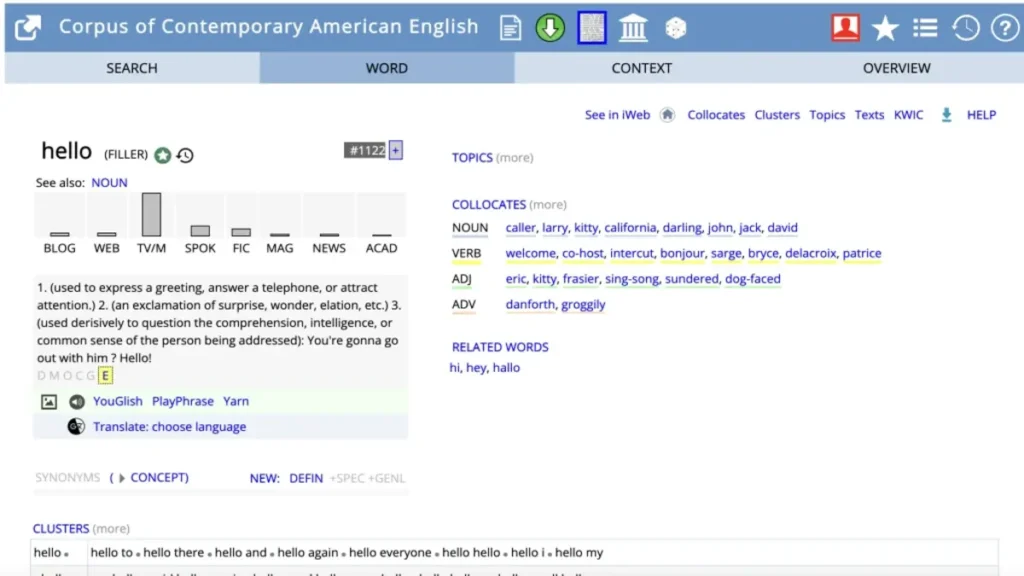
To understand its true value, it’s important to compare COCA with other commonly used tools.
1. COCA vs Traditional Dictionaries
A dictionary helps you understand the meaning of a word. It provides definitions, pronunciation, and sometimes example sentences.
However, dictionaries have limitations.
They often:
- provide limited examples
- do not show frequency of usage
- cannot fully explain how a word is used across different contexts
COCA, on the other hand, allows you to explore real usage. Instead of relying on a few examples, you can analyze hundreds of authentic sentences and see how the word behaves in different situations.
2. COCA vs Grammar Checkers
Grammar checkers are designed to identify errors and suggest corrections. They are useful for fixing mistakes, but they do not always guarantee natural language.
A sentence can be grammatically correct and still sound unnatural.
COCA goes beyond correction. It helps you understand whether a phrase is actually used by native speakers, not just whether it follows grammatical rules.
3. COCA vs Thesaurus Tools
A thesaurus helps you find synonyms, which can be useful for expanding vocabulary.
However, choosing a synonym without understanding its usage can lead to awkward or incorrect expressions.
For example, two words may have similar meanings but are used in completely different contexts.
COCA allows you to compare how each word is used in real sentences, helping you choose the most natural option.
4. COCA vs SEO Writing Tools
SEO tools often focus on keywords, search volume, and optimization. While these are important, they do not always guarantee natural writing.
Content that is overly optimized can feel forced or unnatural to readers.
COCA helps balance this by ensuring that your writing reflects real language usage, making your content more engaging and authentic.
Most language tools focus on rules, corrections, or suggestions.
COCA takes a different approach by showing how English is actually used in real contexts, which makes it far more practical for real-world writing.
Who Should Use COCA (Corpus of Contemporary American English)?
One of the biggest advantages of COCA (Corpus of Contemporary American English) is that it is not limited to a specific group of users. Whether you are learning English or using it professionally, COCA can provide real value.
Understanding who should use COCA will help you see how flexible and practical this tool really is.
1. Writers and Bloggers
If you regularly write articles, blog posts, or any form of content, COCA can help you produce more natural and engaging writing.
Instead of relying on guesswork, you can verify how phrases are actually used. This is especially useful when you want your writing to feel more authentic and less mechanical.
2. Copywriters and Content Creators
For copywriters, every word matters.
COCA helps ensure that the language you use sounds natural, persuasive, and appropriate for your audience. This is particularly important in marketing, where unnatural phrasing can reduce trust and impact.
3. English Learners
For learners at any level, COCA offers a deeper understanding of how English works beyond grammar rules.
By exploring real examples, learners can develop a more intuitive sense of the language, making it easier to form natural sentences over time.
4. SEO Specialists
SEO is not just about keywords — it is also about readability and user experience.
COCA helps you create content that sounds natural while still being optimized. This balance is important for keeping readers engaged and improving overall content performance.
5. Researchers and Linguists
COCA is widely used in linguistic research because of its large and reliable dataset.
Researchers can analyze language patterns, study frequency, and observe how English evolves over time across different contexts.
How to Use COCA (Corpus of Contemporary American English) to Improve Your English Naturally
Using COCA (Corpus of Contemporary American English) is not just about searching for words — it’s about training yourself to understand how English is naturally used in real life.
When used consistently, COCA can help you develop a deeper, more intuitive understanding of the language.
1. Learn from Real Usage, Not Just Rules
One of the most effective ways to improve your English is by observing how it is actually used.
Instead of relying only on grammar rules, use COCA to explore real examples. Pay attention to how native speakers form sentences, choose words, and express ideas.
Over time, this will help you move beyond “correct English” and start producing “natural English.”
2. Build a Strong Sense of Collocations
Natural English depends heavily on word combinations.
By using COCA, you can discover which words commonly appear together and which combinations should be avoided. This helps you develop a more accurate and natural way of expressing yourself.
Rather than memorizing lists, you learn patterns directly from real usage.
3. Understand Context Before Using a Word
A word can have multiple meanings, but its correct usage depends on context.
COCA allows you to see how a word behaves in different situations — whether in spoken language, academic writing, or informal communication.
This makes it easier to choose the right word for the right situation.
4. Observe Patterns and Repetition
Language is built on patterns.
By reviewing multiple examples in COCA, you will begin to notice recurring structures and expressions. These patterns are what make language feel natural.
The more you observe them, the more naturally you will be able to use them yourself.
5. Practice by Imitation
One of the most practical ways to learn from COCA is through imitation.
After finding useful examples, try rewriting similar sentences using your own ideas. This helps reinforce what you’ve learned and builds confidence in using natural expressions.
6. Be Consistent in Your Practice
Like any skill, improving your English requires consistency.
Using COCA occasionally can be helpful, but using it regularly will produce much better results. Even a few minutes of focused exploration can gradually improve your understanding of natural language.
This approach shifts your learning from memorization to observation — from studying rules to understanding real usage.
And that is what makes COCA such a powerful tool for improving your English naturally.
From Rules to Real Usage: Rethinking How You Learn English
For many learners, English is often reduced to a set of rules — grammar structures, vocabulary lists, and textbook examples. While these elements are important, they only represent one side of the language.
Real English is shaped by usage.
It is formed through patterns, habits, and context that develop over time through actual communication. This is why understanding how the language is used in real situations is far more valuable than simply memorizing rules.
COCA (Corpus of Contemporary American English) provides a way to access that reality.
By exploring authentic examples from a wide range of sources, you are no longer limited to theory. Instead, you begin to see how English truly works — how words connect, how meanings shift, and how natural expression is formed.
This shift in perspective is what makes the difference.
When you move from focusing only on correctness to understanding usage, your English becomes clearer, more natural, and more effective.
And in the long run, that is what truly matters.
Leave a Reply