
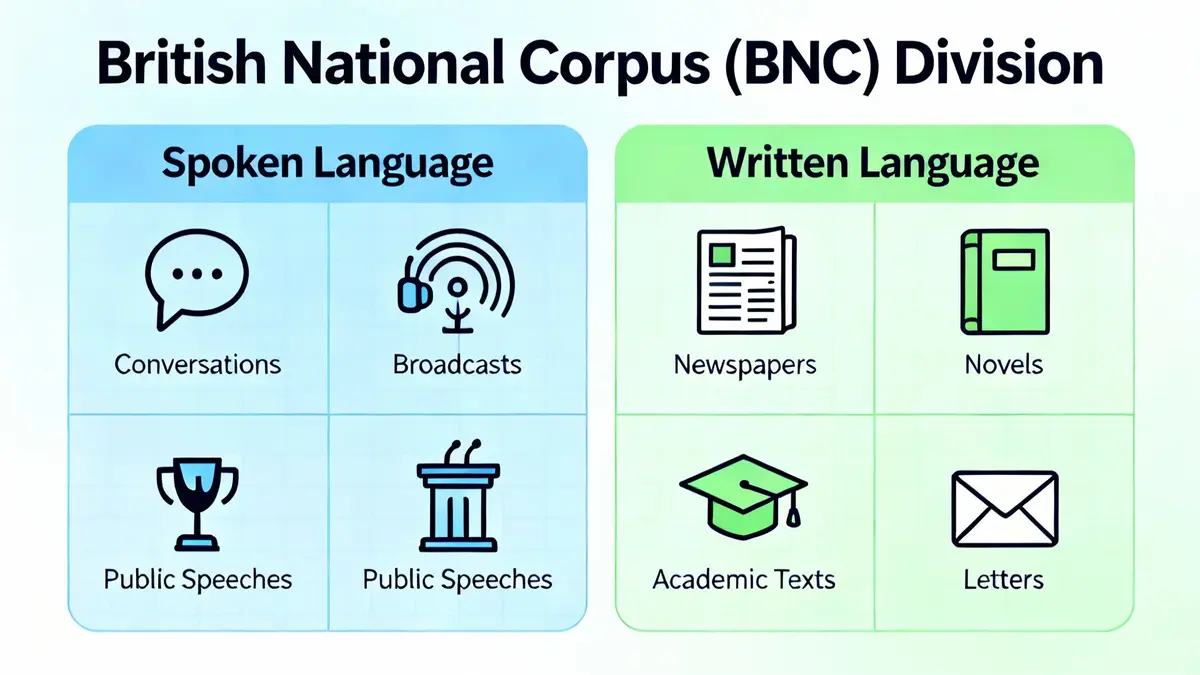
The British National Corpus (BNC) is a large, carefully balanced collection of modern British English, designed to represent how the language was used across a wide range of contexts in the late twentieth century. It contains approximately 100 million words drawn from both written and spoken sources, making it one of the most influential reference corpora in English linguistics.
The corpus focuses exclusively on British English and reflects language use primarily from the early 1990s. By combining everyday spoken interactions with diverse written texts, the BNC provides a broad snapshot of English as it was used by different speakers, in different situations, and for different purposes. For this reason, it has long served as a standard point of reference for linguistic research, lexicography, and language education.
What is the (BNC) British National Corpus?
The British National Corpus is a general-purpose reference corpus created to document how British English is used in real-life communication. Rather than focusing on a single genre or domain, it brings together language from many different sources in order to reflect common patterns of usage across society.
The primary aim of the BNC is descriptive rather than prescriptive. It does not attempt to define how English should be used, but instead records how it is actually used by speakers and writers. This makes the corpus especially valuable for observing frequency, variation, and typical linguistic choices in authentic contexts.
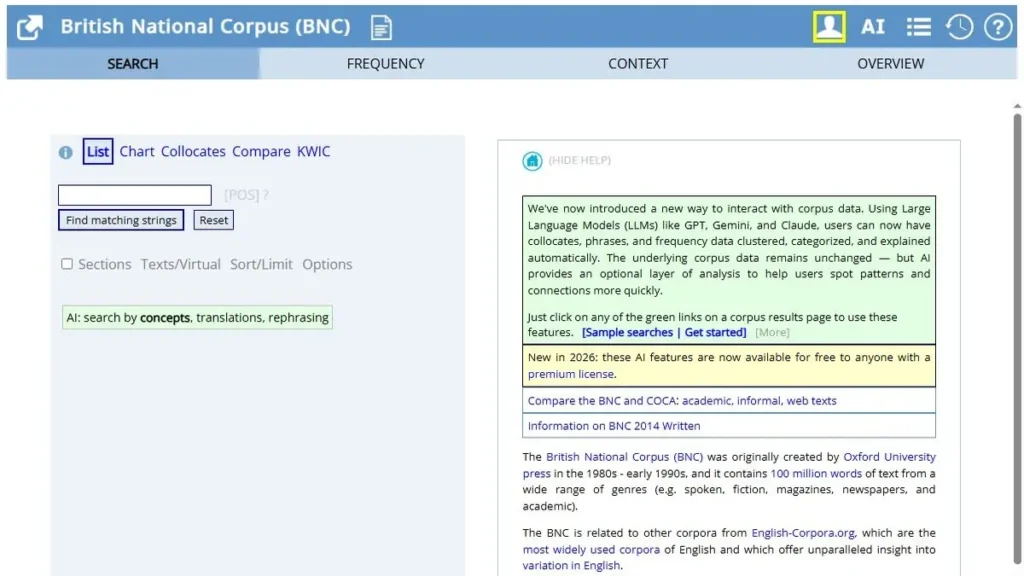
As a reference corpus, the BNC is intended to provide a stable baseline for analysis. Researchers, educators, and language professionals often use it to compare linguistic patterns, test hypotheses about usage, or illustrate how words and constructions function in standard British English.
Size and Composition
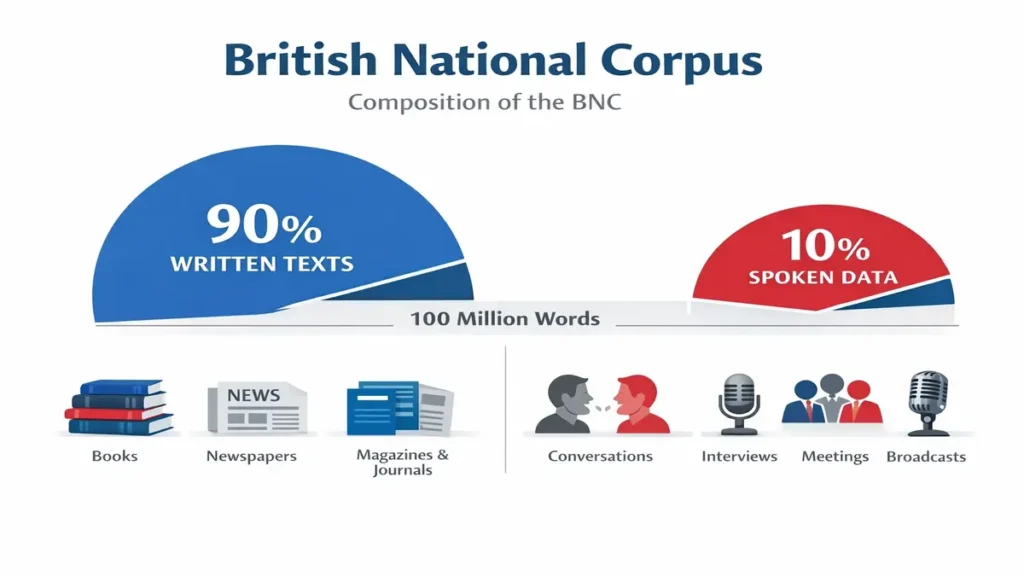
The British National Corpus contains approximately 100 million words, making it one of the largest and most widely used reference corpora for British English. The corpus is carefully balanced to represent both written and spoken language, with around 90% of the content drawn from written texts and 10% from transcribed spoken interactions.
The written component includes a wide variety of sources such as books, newspapers, journals, letters, and other text types, while the spoken component captures conversations, interviews, and broadcasts. Each portion of the corpus is designed to reflect authentic usage across different contexts, ensuring that the BNC provides a comprehensive overview of language as it was used in the early 1990s.
By combining diverse textual materials with spoken language samples, the BNC allows researchers to analyze frequency patterns, common phrases, and structural characteristics in both everyday conversation and formal writing.
Written Component
The written portion of the British National Corpus makes up approximately 90% of the total content and encompasses a broad range of text types. These include published books, newspapers, academic journals, letters, essays, brochures, and other written materials intended to represent everyday language use.
Texts were carefully selected to capture both formal and informal writing, covering diverse subjects and genres. This variety ensures that researchers can study differences in style, vocabulary, and structure across contexts, from literary works to personal correspondence.
By including such a wide spectrum of written material, the BNC provides a reliable snapshot of how British English was used in print and digital texts of the early 1990s, making it a foundational resource for linguistic analysis and reference.
Spoken Component
The spoken portion of the British National Corpus accounts for roughly 10% of the overall material and is composed of transcribed recordings of natural speech. These recordings include everyday conversations, interviews, meetings, telephone calls, and broadcast discussions, providing insight into how British English is used in real-life spoken contexts.
Speakers were selected to represent a wide range of ages, genders, social backgrounds, and regions, ensuring that the corpus reflects the diversity of British English usage. Transcriptions were carefully prepared to maintain accuracy while capturing essential features of spoken language, such as pauses, repetitions, and informal expressions.
By including spoken data alongside written texts, the BNC enables researchers to compare and contrast patterns in formal and informal language, study conversational structures, and observe authentic linguistic choices in natural speech.
Time Period Covered
The British National Corpus primarily reflects the use of British English during the early 1990s. Data collection for both written and spoken texts took place between 1991 and 1994, capturing language as it was used in everyday communication and formal publications of that period.
This specific time frame provides researchers with a snapshot of late 20th-century English, reflecting contemporary vocabulary, idiomatic expressions, and stylistic conventions. While the BNC does not cover historical developments before the 1990s, it serves as a stable reference point for understanding language patterns, frequency of usage, and linguistic trends in modern British English at that time.
Design and Representativeness
The British National Corpus was designed to provide a representative sample of British English, balancing the inclusion of different genres, topics, and social contexts. Its composition reflects a conscious effort to include texts from a variety of written and spoken sources, ensuring that the corpus captures both formal and informal language.
In addition to genre diversity, the BNC accounts for social and demographic variation. Speakers in the spoken component were selected to reflect differences in age, gender, social background, and regional origin, while written texts cover multiple subject areas and registers. This careful design allows the corpus to serve as a reliable reference for studying linguistic patterns, vocabulary usage, and grammatical structures across the spectrum of British English.
Despite these efforts, the corpus has limitations. It primarily reflects English as used in the early 1990s and may not fully represent language changes that have occurred since then. Nevertheless, its breadth and methodological rigor make it a cornerstone for research and reference in corpus linguistics.
Linguistic Annotation
The British National Corpus includes detailed linguistic annotation, providing additional layers of information for researchers and language professionals. Each word in the corpus is tagged with part-of-speech labels, which indicate its grammatical category, such as noun, verb, adjective, or adverb. This tagging allows for precise analysis of syntactic patterns and word usage across different contexts.
In addition to part-of-speech information, the corpus includes metadata about each text, such as source, genre, and demographic details of the speakers or authors. These annotations make it possible to search, sort, and analyze language data efficiently, supporting studies in areas such as frequency analysis, collocation patterns, and stylistic variation.
While the annotation system is technical in nature, it is designed to be accessible to users with varying levels of expertise, making the BNC a versatile tool for both linguistic research and practical applications in language education and computational linguistics.
Accessing the BNC
The British National Corpus can be accessed through several platforms, allowing users to explore and analyze its extensive collection of texts. One of the primary methods is through BNCweb, an online interface that enables searching, concordancing, and frequency analysis across both written and spoken components. Registration may be required to access full features, but the platform is generally available to researchers, educators, and students.
For those interested in offline access, the BNC XML Edition is available for download under specific licensing conditions, providing the complete corpus in a structured format suitable for computational analysis. This edition is particularly useful for advanced research, corpus linguistics studies, and natural language processing applications.
By offering both web-based and downloadable access, the BNC ensures that a wide range of users can utilize its data for academic, educational, and professional purposes.
Typical Uses of the BNC
The British National Corpus is widely used in linguistic research, education, and language technology due to its rich and diverse content. Researchers use the corpus to study patterns of vocabulary, grammar, and syntax, as well as to investigate collocations, frequency distributions, and stylistic variations across different genres.
In language education, the BNC serves as a reference for authentic English usage, helping educators and learners identify common phrases, typical sentence structures, and context-appropriate vocabulary. It also informs the development of teaching materials and dictionaries by providing real-world examples of language in use.
The corpus is equally valuable in computational linguistics and natural language processing (NLP), where it is employed for training and evaluating algorithms, language models, and tools for automated text analysis. Its comprehensive coverage of both written and spoken English ensures that applications built on the BNC data reflect authentic language patterns.
Strengths and Limitations
The British National Corpus offers several key strengths that make it an invaluable resource for linguistic study. Its large size and careful balance between written and spoken language provide a representative snapshot of British English from the early 1990s. The corpus covers a wide range of genres, social contexts, and demographic variations, allowing for detailed analysis of vocabulary, grammar, and usage patterns. Additionally, its structured annotations, including part-of-speech tagging and metadata, facilitate efficient research and computational applications.
However, the BNC also has limitations. Since it reflects language primarily from the early 1990s, it may not capture more recent changes in vocabulary, syntax, or usage patterns. Its focus on British English means that it is less suitable for studying varieties of English outside the UK. Despite these constraints, the BNC remains a foundational reference corpus, widely cited and used as a benchmark in both academic research and practical applications.
How the BNC Compares to Other Corpora
The British National Corpus holds a unique position among English language corpora as one of the earliest and most comprehensive reference corpora for British English. Unlike specialized corpora that focus on specific genres, time periods, or spoken contexts, the BNC provides a broad, general-purpose dataset that captures both written and spoken language across a wide range of domains.
While more recent corpora, such as the Corpus of Contemporary American English (COCA) or the NOW Corpus, offer larger datasets or continuously updated content, the BNC remains a benchmark for comparative studies, historical analyses, and foundational research. Its structured design, representativeness, and widespread use make it a standard reference point for linguists, educators, and language technology developers seeking to understand patterns in modern British English.
Why the BNC Matters
The British National Corpus continues to be an essential resource for anyone interested in understanding British English as it was used in the early 1990s. By providing a balanced collection of written and spoken language across a wide range of genres, contexts, and social backgrounds, the BNC allows researchers, educators, and language enthusiasts to study authentic language patterns with confidence.
Its comprehensive design and careful annotation make it useful not only for linguistic research, but also for teaching, dictionary development, and computational applications. Even decades after its creation, the BNC remains a benchmark for comparative studies and a reference point for new corpora, helping users appreciate both the stability and variation inherent in modern British English.
Leave a Reply